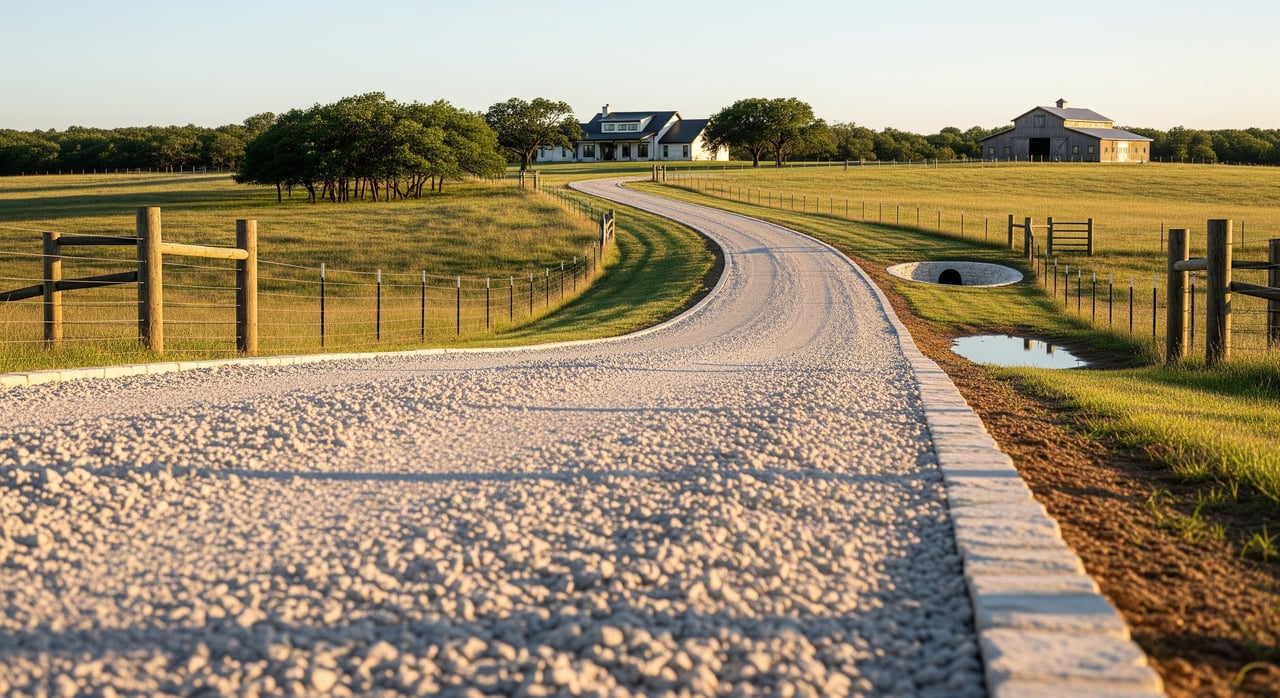
If you own acreage near Marietta, you know a good ranch road or driveway can make daily life easier and protect your investment. The challenge is that southern Oklahoma weather, clay soils, and heavy vehicles can turn a quick gravel drop into ruts and washouts. With a little planning, you can build a road that sheds water, holds its shape, and stays drivable year-round.
In this guide, you’ll learn how to pick the right gravel, set the proper crown and drainage, and know when to coordinate with Love County or the state. You’ll also get simple checklists to use with your contractor. Let’s dive in.
Choose the right gravel
Picking the right material matters more than just adding rock. Local conditions around Love County include warm, humid summers, intense thunderstorms, and clay-rich soils in places. That means you want a stable base, a smart surface layer, and attention to drainage.
Base vs. surface materials
- Base course: Look for dense, angular crushed stone with fines. It compacts tightly and forms a stable platform. Many suppliers call this road base, crusher run, or dense grade aggregate.
- Surface course: Smaller, clean crushed stone, often 3/4 or 3/8 inch, works as a wearing layer. It smooths out the ride and resists displacement.
- Recycled asphalt (RAP): Packs well and can help with dust. It may soften in very hot weather. Use with awareness of potential oil residue.
Best picks for Oklahoma conditions
- Crushed limestone is a strong default in this region. The fines help it bind and compact, which improves traction and reduces dust.
- For heavier traffic or frequent farm equipment, consider a layered approach. Build a thicker base, then add a thinner surface layer that you can renew every few years.
What to avoid
- Pea gravel or rounded stone slides more easily and needs edge restraint. It is not ideal for main surfaces where traction and containment matter.
- Skipping a compacted base on clay subgrade often leads to pumping, ruts, and repeated rework.
Dust control options
- Regular grading and compaction help manage dust naturally.
- Some owners use salts or polymer suppressants. These can work, but they have trade-offs for corrosion and environment. Consider professional advice and local guidance before applying.
Build it right: base, crown, and compaction
Good construction is about layers, slope, and separation from clay. A stable base and proper cross-slope will save you money over time.
Thickness by use and load
- Light residential use: Many driveways perform well with about 4 to 6 inches of compacted crushed stone base if the subgrade is firm.
- Heavier private roads or frequent farm traffic: Plan for 6 to 12 inches of compacted base. A common approach is 6 to 8 inches of base plus 2 to 3 inches of surface stone.
- Weak or clay-heavy subgrades: Add geotextile and increase thickness by 2 to 4 inches or more. This reduces mixing of clay with your base and spreads loads.
Geotextile on clay subgrades
If you see soft, pumping spots or your site is known for clay, use geotextile fabric under the aggregate. It separates the rock from the subgrade, improves stability, and cuts down on long-term rutting.
Set the crown to shed water
Your road needs a slight crown so water moves off the surface quickly.
- Aim for 4 to 6 percent total cross-slope on unpaved roads. That equals about 2 to 3 percent from center to each edge.
- A practical rule of thumb is about 1/4 to 1/2 inch of drop per foot from the centerline to the edge.
- For short, paved sections or small aprons, 2 to 4 percent can be enough.
Keep the crown consistent along the route. If puddles show up after rain, regrade those sections and restore the cross-slope.
Manage longitudinal grade
Steep runs increase runoff speed and erosion. Where you can, keep sustained grades below about 10 to 12 percent. Short steeper sections can work if stabilized with proper base, cross-drains, or rolling dips. If traction is poor in wet weather, consider additional measures like surface refresh, improved cross-slope, or cross-drain features.
Compact in lifts
Compact the aggregate in 2 to 4 inch lifts using a vibratory roller or plate compactor for edges. Wheel rolling by vehicles is not a substitute for planned compaction.
Drainage that survives summer storms
Love County can get fast, heavy downpours. Your driveway or ranch road should move water safely off the surface and into stable ditches and culverts.
Ditches and stable channels
- Shape the ditches to carry expected flow without eroding.
- Line slopes with grass, rock, or erosion mats where needed.
- Keep vegetation maintained so water can move without blockage and you maintain visibility at access points.
Culvert basics
Culverts carry water under the driveway and keep surface flows off your road.
- Materials often include corrugated steel, HDPE plastic, or concrete.
- Proper bedding and compaction around the pipe matter as much as the pipe itself.
- Outlet protection is critical. Use rock armoring to prevent scour and washouts.
Culvert size depends on drainage area and design storm. Many counties set minimums in the 12 to 18 inch range for residential drives, but larger diameters are needed if your upstream drainage area is bigger. Confirm expectations with Love County for any approach to a county road. If your drive connects to a state highway, coordinate with the state for access standards.
Erosion control where water exits
- Place riprap over geotextile at culvert outlets and in high-energy zones.
- Use check dams, rock-lined swales, or vegetated buffers below outlets to slow water.
- During construction, use temporary controls like silt fence or wattles to keep sediment in place.
Permits and who to call
If your driveway connects to a public road, plan ahead. Requirements can differ between a county road and a state highway.
Love County vs. state highways
- County roads: Contact Love County Road and Bridge or the County Commissioners office about driveway or approach permits, culvert specs, and right-of-way limits.
- State highways: If your access ties into a state highway, contact the Oklahoma Department of Transportation for access rules, permits, and sight distance standards.
- Work in public right-of-way: Do not place fill, culverts, or excavation in the right-of-way without permission. Unpermitted work can be subject to removal or fines.
Simple checklist before you start
Use this as a quick plan you can share with your contractor.
- Confirm whether the connecting road is county or state managed.
- Locate your property boundary and the public right-of-way. The county clerk or assessor can help with plats and records.
- Call the county to request driveway or approach permit details and any standard drawings.
- Sketch a simple site plan with grades, proposed culvert location, widths, and expected vehicle loads.
- Ask about minimum culvert diameters, accepted materials, and installation standards. Confirm who inspects and when.
- If on a state highway, request ODOT access permit information and sight distance requirements.
- If near a creek or mapped floodplain, check floodplain requirements and any extra permits.
- Call 811 before any excavation to locate utilities.
- Keep copies of permits and approvals on site during construction.
- Schedule any required post-construction inspection.
Questions to ask contractors
- How will you size the culvert based on drainage area and design storm? Will you provide basic calculations or a rationale?
- Will you use geotextile under the base where the subgrade is soft or clay-rich?
- What aggregate gradation will you use for base and surface, and how will you compact each lift?
- How will you set and maintain the crown and ditches to protect the road during and after construction?
- Do you coordinate with county inspectors for approach acceptance if required?
- Do you provide a written warranty for culverts, headwalls, and workmanship?
Maintenance plan for long life
Routine care costs less than rebuilding after a washout. Set a simple maintenance rhythm.
Seasonal tasks
- After heavy storms: Inspect ditches and culverts. Clear debris and check for outlet erosion.
- Spring: Regrade ruts, restore the crown, and add surface stone if needed.
- Summer: Monitor dust. Consider light watering for short-term events or discuss longer-lasting dust control with a pro.
- Fall: Trim vegetation along edges and near sight lines. Check drainage ahead of winter rains.
Regravel and grading frequency
- Many gravel drives benefit from regrading once a year or every 1 to 2 years based on traffic.
- Plan to top-dress with 1 to 3 inches of surface aggregate as needed. Full resurfacing with several inches may be needed every 3 to 7 years depending on wear and weather.
- If the same spot keeps ponding or rutting, it likely needs deeper fixes. Consider geotextile, thicker base, or a drainage change.
Records, easements, and shared drives
If you share a driveway or cross an easement, clarify responsibilities in writing. Confirm who maintains what, and keep copies with your property records. For complex situations, steep slopes, or heavy truck use, consider bringing in a civil engineer for a road section and drainage plan. That upfront work can prevent neighbor issues and expensive rework later.
Ready to plan your next step?
A well-built driveway or ranch road boosts daily usability and protects your acreage from erosion. If you are weighing improvements before selling or want to budget upgrades after buying, let’s talk through your options, materials, and permit path in Love County and Southern Oklahoma. Reach out to Unknown Company to get expert, practical guidance tailored to your property.
FAQs
What gravel mix works best for a rural driveway in Love County?
- Use a compacted crushed stone base with fines for structure, then a smaller crushed stone surface layer for smoother driving and durability. Avoid pea gravel as a main surface.
How much base gravel do I need for farm equipment traffic?
- Many heavier-use drives perform with 6 to 12 inches of compacted base, plus a 2 to 3 inch surface layer. Increase thickness and add geotextile on clay subgrades.
What crown should I set on an unpaved ranch road?
- Target about 4 to 6 percent total cross-slope, which equals 1/4 to 1/2 inch drop per foot from the center to the edge. Keep the crown consistent to prevent ponding.
Do I need a permit for a driveway onto a county road in Love County?
- In many cases, yes. Contact the Love County Road and Bridge or County Commissioners office for approach permits, culvert specs, and right-of-way rules before work begins.
When should I contact the Oklahoma Department of Transportation?
- If your driveway connects to a state highway, coordinate with the state for access permits, sight distance, and approach standards before construction.
How often should I regrade and regravel my driveway in southern Oklahoma?
- Many drives are regraded annually or every 1 to 2 years, with top-dressing of 1 to 3 inches as needed. Full resurfacing may be needed every 3 to 7 years based on traffic and weather.